


Senolytic Drugs Improve Memory and Reduce Brain Cholesterol During Aging
Senolytic drugs dasatinib and quercetin improved memory in mice with accelerated aging while reducing cholesterol buildup and inflammation in the brain.
Highlights
- Dasatinib and quercetin improve working and recognition memory in a mouse model of accelerated aging.
- Senolytic treatment reduces cholesterol and lipid accumulation in astrocytes, cells that regulate metabolism and support neurons in the brain.
- Experimentally restoring cholesterol production weakens the anti-aging effects, identifying astrocyte cholesterol metabolism as a potential target for cognitive aging.
The brain contains roughly one-quarter of the body’s cholesterol despite accounting for only about 2% of body weight. Most brain cholesterol must also be produced locally because circulating cholesterol cannot readily cross the blood-brain barrier. This tightly regulated lipid supply supports neuronal membranes and communication, but cholesterol metabolism can become disrupted with age.
Astrocytes play a major role in maintaining this balance. These support cells produce and distribute cholesterol throughout the brain, while aging can cause astrocytes to accumulate excess lipids and enter cellular senescence. Senescent cells stop dividing but remain metabolically active, releasing inflammatory molecules that can damage surrounding tissue.
Researchers have increasingly investigated senolytic drugs, which selectively eliminate senescent cells, as a way to counter this process. A new study published in the journal Mechanisms of Ageing and Development examined the combination of dasatinib and quercetin and found that treatment improved memory in mice while suppressing cholesterol production in astrocytes. The findings connect two features of brain aging that researchers often study separately: cellular senescence and disrupted lipid metabolism.
Dasatinib and Quercetin Improved Memory
Researchers used young male mice exposed to D-galactose for eight weeks to induce features associated with accelerated aging, including oxidative stress (the buildup of harmful, reactive molecules in cells), inflammation, mitochondrial dysfunction, and cellular senescence (a dysfunctional state where cells can emit inflammatory molecules). Two weeks after starting D-galactose, one group began receiving daily oral doses of dasatinib at 5 mg/kg and quercetin at 50 mg/kg for six weeks.
Dasatinib is a prescription cancer drug, while quercetin is a plant-derived compound commonly sold as a dietary supplement. Together, D+Q represents one of the most widely studied senolytic combinations.
The treatment reduced signs of cellular senescence in the hippocampus, a brain region essential for learning and memory. Levels of the senescence-associated proteins p16 and p21 also declined.
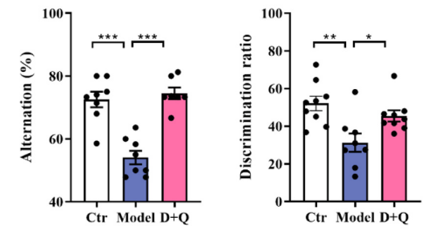
The researchers then tested whether these biological changes translated into better cognitive function. D+Q-treated mice performed significantly better in a test of spatial working memory, the ability to temporarily remember and use information about their surroundings, and a novel object recognition test that measures recognition memory, the ability to distinguish something previously encountered from something new. Differences in movement and exploratory behavior did not explain the improvement, strengthening the evidence that treatment affected memory itself.
Senolytics Changed Cholesterol Metabolism in the Brain
The researchers analyzed thousands of proteins and lipids in the hippocampus to determine what might explain the cognitive improvement. Their analysis pointed strongly toward cholesterol metabolism.
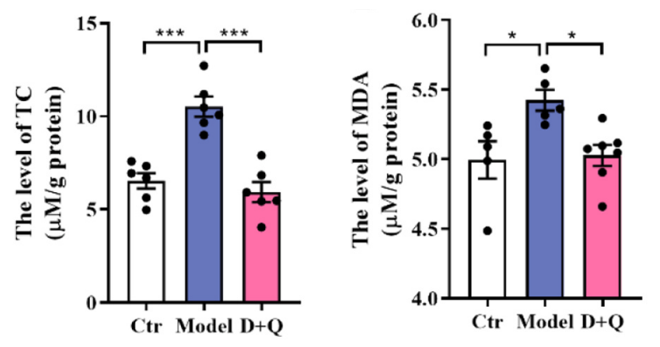
D-galactose exposure increased several types of lipids in the hippocampus, including ceramides and phospholipids. D+Q reversed much of this accumulation. The treatment also reduced several proteins involved in cholesterol production, indicating that senolytics were suppressing the brain’s cholesterol biosynthesis pathway.
Total hippocampal cholesterol declined after treatment. Levels of malondialdehyde, a marker of lipid peroxidation and oxidative damage, also fell. These changes matter because excess or poorly regulated lipids can increase oxidative stress and interfere with cellular function in the aging brain.
Astrocytes Connected Cholesterol to Brain Inflammation
The researchers traced much of the lipid accumulation to astrocytes. Although astrocytes support neurons and regulate brain cholesterol under healthy conditions, aging can alter their metabolism and promote an inflammatory state.
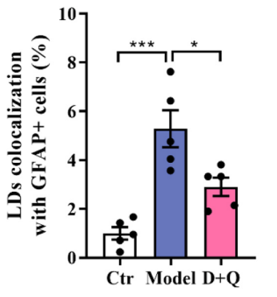
D+Q reduced lipid droplets inside hippocampal astrocytes and decreased markers of astrocyte activation. The treatment also reduced activation of microglia, another immune-related cell population in the brain, without evidence of increased neuronal loss.
Inflammatory signaling declined at the same time. Levels of IL-1β, TNF-α, and IL-6 were significantly lower in the hippocampus after treatment. The combined results suggest that excess lipid accumulation in aging astrocytes may help sustain the inflammatory environment associated with cognitive decline.
Blocking Cholesterol Production Reduced Cellular Senescence
The researchers used cultured astrocytes to test whether the cholesterol changes contributed directly to the senolytic effects. D+Q lowered cholesterol and senescence markers in cells exposed to D-galactose. Researchers then pharmacologically reactivated cholesterol synthesis. Restoring the pathway increased cholesterol and weakened the reduction in cellular senescence produced by D+Q.
A second experiment produced similar results by increasing Hsd17b7, a protein involved in cholesterol synthesis. Hsd17b7 overexpression raised cellular cholesterol, increased a marker of senescence, and increased inflammatory signaling despite senolytic treatment.
These results suggest that reducing cholesterol production plays an important role in the effects of D+Q. When researchers restored cholesterol production, the treatment became less effective at reducing cellular senescence.
Brain Lipid Metabolism Could Become a Target for Cognitive Aging
Cellular senescence has attracted attention as a potential driver of age-related disease because senescent cells accumulate in many tissues and can promote chronic inflammation. The new findings suggest that the metabolic state of these cells may be equally important for understanding how they damage the aging brain.
Astrocytes occupy a particularly important position in this process because neurons depend on them for metabolic and lipid support. Excess cholesterol production and lipid storage could therefore connect astrocyte senescence with oxidative stress, inflammation, and impaired neuronal function. Targeting this metabolic dysfunction may eventually provide another route for protecting cognition.
The study does not establish D+Q as a treatment for cognitive aging. Researchers used young male mice subjected to chemically accelerated aging rather than naturally aged animals, and the authors note that studies in naturally aged and neurodegenerative models are still needed. Dasatinib and quercetin also have biological effects unrelated to senescent-cell clearance, making it difficult to determine how much of the cholesterol response came specifically from their senolytic activity.
The more significant finding may be the connection between two established features of brain aging. Cellular senescence can alter the metabolism of the cells that accumulate with age, while disrupted lipid handling can reinforce inflammation and cellular dysfunction. The ability to interrupt that cycle in astrocytes identifies cholesterol regulation as a potential component of future strategies designed to preserve cognitive function during aging.
Model: Eight-week-old male C57BL/6J mice treated with 200 mg/kg/day of D-galactose via intraperitoneal injection for eight weeks to induce accelerated aging.
Dosage: 5 mg/kg/day of dasatinib and 50 mg/kg/day of quercetin (D+Q), administered orally by gavage for six weeks, beginning two weeks after the start of D-galactose treatment.
 Comments