


Buck Institute Study: Ketone Supplement Curbs Age-Related Immune Changes
Ketone esters reduce age-related activation of a type of white blood cell—age-related B cells—which can contribute to age-related autoimmunity, without impairing immune responses in aged mice.
Highlights
- Supplementing aged mice with ketone esters (compounds taken to raise molecules called ketone bodies, which help fuel the body during fasting or a low-carbohydrate diet) reduced age-associated B cell activation, which is implicated in age-related autoimmunity.
- Despite reduced B cell activation, supplemented mice maintained normal immune responses to an experimental vaccine-like immunization.
A non-peer-reviewed article published on Research Square by scientists at the Buck Institute for Research on Aging shows that 15 weeks of ketone ester supplementation reduced the activation of subsets of white blood cells, called age-related B cells, in aged mice. These age-associated B cell subsets are implicated in age-related autoimmunity.
Despite the reduced activation of these B cells, supplemented mice mounted a normal immune response in response to a vaccine-like immunization, with increased levels of antibodies—proteins made by immune cells that help the immune system recognize and defend against threats like bacteria and viruses. Furthermore, follow-up experimentation revealed that supplemented mice had higher circulating levels of the ketone β-hydroxybutyrate and that this ketone directly altered B cell activity, notably by suppressing B cell protein synthesis. These findings suggest that ketone ester supplementation may help reduce certain B-cell activation and limit age-related autoimmunity.
The Prevalence of Age-Related Autoimmunity
Age-related autoimmunity refers to immune responses against the body’s own molecules that emerge or become more prominent as the immune system ages. It reflects a paradox of immune aging: defenses against infections can become less effective even as inappropriate responses against the body increase.
The immune system normally maintains “self-tolerance”—safeguards that prevent immune cells from attacking healthy tissues. Aging can disrupt these safeguards while also changing the signals that activate immune cells. Several interconnected processes may contribute:
- Weaker control of self-reactive cells: Changes in the checkpoints that remove or restrain self-reactive B cells can allow inappropriate immune responses to develop.
- Chronic inflammation: Aging often brings persistent, low-grade inflammation, sometimes called “inflammaging,” which can facilitate the activation and expansion of self-reactive immune cells.
- Changes in B cell populations: Age-associated B cells accumulate with aging and in several autoimmune diseases. These cells can produce self-reactive antibodies, release inflammatory molecules, and present the body’s own antigens (molecules that the immune system recognizes) to immune cells, potentially sustaining an autoimmune response.
Interestingly, age-related autoimmunity, measured by the presence of self-reactive antibodies, is very common in older adults, though this does not always mean a person has or will develop a clinical autoimmune disease. Along these lines, up to 15% to 22% of older adults aged 70 and older test positive for self-reactive antibodies, roughly double the rate seen in younger populations between the ages of 12 and 19. Since aging is associated with increased autoimmunity, greater susceptibility to infections, and weaker vaccine responses, the need for interventions that limit harmful autoimmune activity while preserving protective responses is important.
More Information on Ketone Esters
Ketone esters are compounds that have been shown to elevate circulating levels of ketone bodies—acids the body produces when it breaks down fat for energy instead of sugar. Normally, the body uses sugar from carbohydrates as its main energy source. However, if the body cannot access enough sugar (due to fasting, a low-carbohydrate diet, or prolonged exercise), it starts burning stored fat instead. In this process, when the liver breaks down fatty acids (building blocks of fats), it releases ketone bodies into the bloodstream to fuel the heart, muscles, and brain. Accordingly, rather than inducing the liver’s release of ketone bodies, in their study, the Buck Institute scientists supplemented mice with ketone esters to elevate circulating ketone bodies.
Previous research has suggested that raising ketone bodies with ketone ester supplementation could reduce inflammation and influence immune cell function, without requiring fasting, a strict low-carbohydrate diet, or prolonged exercise. Importantly, the researchers initially investigated ketone ester supplementation on immune aging broadly; the possible relevance of ketone esters to age-related autoimmunity emerged from findings pertaining to B cells.
Ketone Ester Supplementation Reduced Certain Subsets of Age-Associated B Cells
To confirm that ketone ester supplementation increases circulating ketone bodies in aged mice, the scientists fed 19-month-old male mice (roughly equivalent to 60-year-old humans) a diet containing the ketone ester bis-octanoyl (R)-1,3-butanediol for 15 weeks. The supplemented diet significantly increased circulating β-hydroxybutyrate (a ketone that accounts for about 78% of the body’s total ketone bodies).
Because B cells are important in age-related autoimmunity, the researchers sought to gauge the abundance of age-associated B cells in ketone ester-supplemented mice. Age-associated B cells are not a single uniform population; they comprise multiple subsets defined by different marker expressions and functional states. To gauge the abundance of B cells, the researchers measured multiple B cell markers in the spleen—a major housing and activation site of B cells. Notably, in the spleens of supplemented mice, the researchers found significantly lower levels of two out of four markers for age-associated B cells. This finding suggested a reduction in the abundance of certain age-associated B cells with the ketone ester supplement.
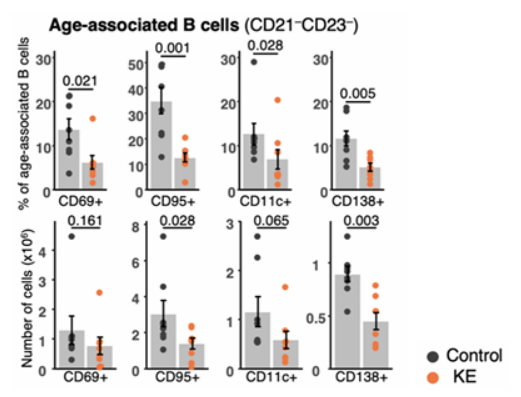
Because B cells differentiate into specialized cells called plasma cells that produce antibodies, the researchers wondered whether reductions in certain age-related B cells would impair antibody responses to an immunization. To test this, they administered a vaccination-like immunization to the ketone ester-supplemented mice and found that these mice still produced antibodies to a similar degree as non-supplemented mice. This finding showed that the reduction in markers for certain subsets of age-associated B cells did not translate into a detectable impairment in the antibody response elicited by the immunization. This did not, however, establish that all immune defenses were unaffected or that vaccine responses improved.
To find whether the ketone ester supplement influences cellular pathways related to B cells, the scientists extracted B cells from aged mice. They treated the B cells with the ketone ꞵ-hydroxybutyrate (a ketone that significantly increased in circulation with ketone ester supplementation). The researchers found that ꞵ-hydroxybutyrate significantly suppressed B cell protein synthesis, which could provide a mechanistic connection for how ketone ester supplementation lowered the abundance of certain kinds of B cells. As such, since ketone ester supplementation increases ketone bodies like ꞵ-hydroxybutyrate, such ketone bodies could also suppress the synthesis of proteins in these B cells, which are required for their growth and function. This could be one way that increased circulating ketone levels with ketone ester supplementation reduces the abundance of age-associated B cells to possibly counter age-related autoimmunity.
“Our study highlights a new immunoregulatory mechanism of ketone bodies in B cells and positions ketone esters as a promising intervention worth testing in models for age-related autoimmunity,” say the scientists in their publication.
A Potential Way to Modify Immune Aging With Ketone Ester Supplementation
The study’s most intriguing finding is the possibility of reducing age-associated B cell levels without compromising the antibody responses tested. Rather than broadly suppressing immunity, ketone ester supplementation appeared to modify selected B cell populations while leaving their response to an experimental immunization intact. This distinction matters because an intervention against age-related immune dysfunction would ideally limit harmful responses without weakening protection against infection. However, the experiment demonstrated preserved, not improved, antibody responses, and did not test protection against infectious disease.
The laboratory findings offer a possible explanation for these effects. β-hydroxybutyrate reduced protein synthesis in B cells. This observation suggests that ketone bodies can influence the cellular processes supporting B cell activation. Nevertheless, the study did not establish that suppressing protein synthesis caused the reduction in particular B cell subsets, or that these cellular changes would translate into less autoimmune damage.
Several limitations temper the findings. The experiments involved aged mice, and changes measured primarily in the spleen may not represent effects throughout the immune system. In addition, several analyses used small samples and exploratory comparisons without adjustment for multiple testing, making independent replication important.
The next step is to determine whether these changes produce meaningful benefits in models of autoimmune disease, for example, by reducing disease-associated self-reactive antibodies, tissue damage, or symptoms, while maintaining responses to infections and immunizations. Human studies would then be needed to establish whether comparable effects occur in older adults and to determine an appropriate dose, duration, and long-term safety profile. For now, this study supports further investigation of ketone esters as regulators of immune aging, not their use as an established treatment for age-related autoimmunity. Nonetheless, for those wanting to hedge their bet on the possible benefits of ketone esters against age-related autoimmunity, supplies of them in various quantities are available online for prices ranging from about $60 to $117.
Model: 19-month-old C57BL/6JN mice
Dosage: A ketone ester diet (containing 20% of the ketone ester bis-octanoyl (R)-1,3-butanediol) for 15 weeks
 Comments